Shopping Cart


Wormwood (Artemisia absinthium) – Cut Herb
€5.00
Tax included
Finely cut herb of wormwood, Artemisia absinthium, a perennial of the daisy family (Asteraceae) native from Europe to Siberia and North Africa. The supplier gives Hungary as the origin. Herborist packs it in 100 g, 500 g or 1 kg pouches, sold as a collectible botanical item, not for consumption.
- Botanical name: Artemisia absinthium L.
- Family: Asteraceae (daisy family)
- Synonyms: Absinthium officinale, Absinthium vulgare, Artemisia inodora
Smartshop · Artemisia absinthium L. · 100 g / 500 g / 1 kg
Finely cut Artemisia absinthium from Hungary
This pouch holds the finely cut herb of Artemisia absinthium, the plant known in English as wormwood, absinthe wormwood or absinthium. The Herborist label names the plant and the plant part, herb. The supplier listing linked to this product describes the form as finely cut and gives Hungary as the country of origin, which lies within the native range of the species. Mycotrop offers 100 g, 500 g and 1 kg of the same material.
- 100 g / 500 g / 1 kg
- Asteraceae
- Herb
- Finely cut
- Botanical name
- Artemisia absinthium L.
- Family
- Asteraceae (daisy family)
- Synonyms
- Absinthium officinale, Absinthium vulgare, Artemisia inodora
- Common names
- Wormwood, absinthe wormwood, absinthium
- Plant part
- Herb (as labelled)
- Form
- Finely cut
Traditional use and composition
Artemisia absinthium, wormwood, is an aromatic member of the daisy family found in Europe and western Asia, known since ancient Greece for its very bitter taste (Polito et al. 2024). In the nineteenth century absinthe, a liqueur based on its essential oil, became very popular; the plant is also used as a spice and as a bittering agent in vermouths (Szopa et al. 2020).
The essential oil contains thujones, sabinyl acetate and camphene in variable proportions. The herb also holds bitter sesquiterpene lactones, including absinthin, and flavonoids.
| Known compounds | Essential oil (0.2 to 1.5% depending on climate) of variable composition: α- and β-thujone, sabinyl acetate, camphene, azulenes. Bitter sesquiterpene lactones, including absinthin, and flavonoids. |
|---|---|
| Traditional use | Europe and western Asia: bitter herb of the herbals; in the nineteenth century, the base of absinthe; spice and ingredient of vermouths. |
| State of research | Mostly laboratory and animal studies on the oil and lactones (2020 review). No health claim is authorised for this plant in the EU. |
Good to know
- The essential oil contains thujones: according to a 2020 review, at high intakes the plant acts on the central nervous system and can cause convulsions and hallucinations.
- Abuse of absinthe, the liqueur, has been linked to irreversible damage to the central nervous system (Szopa et al. 2020).
- According to the same review, the plant should be avoided during pregnancy and breastfeeding: in pregnant rats it hindered embryo implantation (Szopa et al. 2020).
The plant
Carl Linnaeus named Artemisia absinthium in Species Plantarum in 1753. Flora Helvetica describes a plant 30 to 80 cm tall, usually upright and branched, with an aromatic scent. The stems are covered in grey felt and woody at the base. The leaves are divided two or three times into narrow lobes of 1 to 3 mm and are grey-felted on both sides. Numerous flower heads, each 3 to 4 mm across, sit in a dense panicle; they carry yellow tubular florets and no ray florets. The fruits are 1 to 2 mm long and have no pappus. In Switzerland the plant flowers in July and August.
Native range
The World Checklist of Vascular Plants (WCVP) of the Royal Botanic Gardens, Kew, sums up the native range as Europe to Siberia and the western Himalaya, plus North Africa. Its list includes Hungary, Romania, Austria, Germany, France, Spain, Türkiye, Iran, the Central Asian republics and Morocco. The species has been introduced across much of the Americas, in Australia and New Zealand, and in parts of Asia.
Label, contents and a related plant
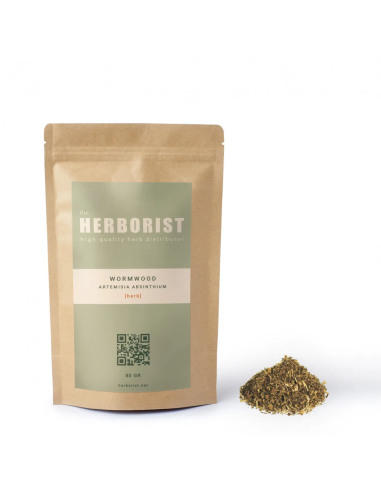
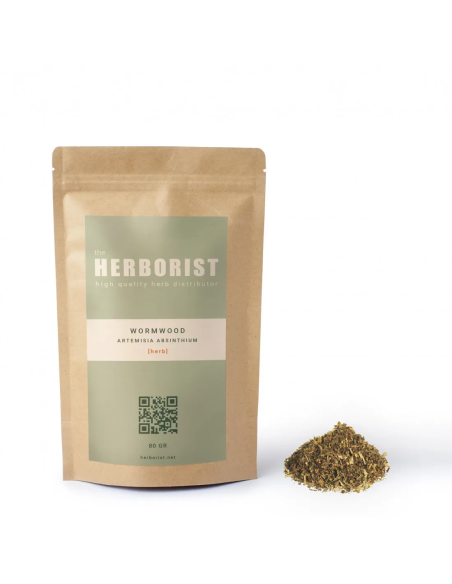
The product photo shows a kraft-paper pouch with a sage-green Herborist label reading "Wormwood", "Artemisia absinthium" and "[herb]", next to a heap of finely cut, greenish-brown herb with small stem pieces. The same genus appears elsewhere in the shop as desert sage from the USA, Artemisia tridentata, sold as a leaf bundle.
Storing your botanicals
Keep dried plants in their tightly closed pouch or in an airtight jar, away from light, moisture and heat. Powders absorb moisture easily, so close them again straight away. For extracts, tinctures and capsules, follow the instructions on the label and the printed date.
Before using a plant
- Keep plants out of the reach of children and pets.
- If you are pregnant or breastfeeding, or taking any medication, ask a doctor or pharmacist first: many plants interact with medicines.
- Stop immediately if you have an allergic reaction or feel unwell.
- The information on this page describes the product; it does not replace medical advice.
Specifications
| Botanical name | Artemisia absinthium L. |
|---|---|
| Family | Asteraceae (daisy family) |
| Synonyms | Absinthium officinale, Absinthium vulgare, Artemisia inodora |
| Common names | Wormwood, absinthe wormwood, absinthium |
| Plant part | Herb (as labelled) |
| Form | Finely cut |
| Origin | Hungary (supplier listing) |
| Pack sizes | 100 g, 500 g, 1 kg |
| Supplier | Herborist |
| Sold as | Collectible botanical item; not for consumption |
Discreet delivery
Orders are packed on working days and leave in plain outer packaging that does not describe the contents. Once your order has shipped, we email you the tracking link when one is available. Estimated delivery times, right of withdrawal and exceptions: Delivery, tracking and returns.
Sources: Szopa et al. 2020, Plants 9(9):1063; Polito et al. 2024, Plants 13(7); supplier information; Plants of the World Online (Kew); GBIF. Updated 3 October 2026 by the Mycotrop team.
Frequently asked questions
What is wormwood (Artemisia absinthium) traditionally associated with?
It has been known since antiquity for its very bitter taste. In the nineteenth century absinthe, a liqueur based on its essential oil, became very popular, and the plant is used as a bittering agent in vermouths. The oil contains thujones.
Why is wormwood also called absinthium?
Absinthium and absinthe wormwood are old common names for the plant itself, recorded next to wormwood in plant checklists. The species epithet absinthium keeps that name in the botanical name.
Which pack sizes are available?
Three: 100 g, 500 g and 1 kg of the same finely cut herb.
Where does it come from?
The supplier listing gives Hungary, which is part of the native range recorded by WCVP. The pouch label names no country.
Is the herb whole or cut?
Finely cut. The supplier listing gives the form as finely cut, and the photo shows small pieces of leaf and stem.
0013-100
27 Items
No reviews
Reviews are limited to verified purchases.
FAQs
-
What is Mycotrop?
Mycotrop is an online shop offering carefully selected smartshop, mycology, botanical, cannabis seed, grow kit, spore, culture, extract, and related products. Our goal is to provide quality products, clear information, secure payment options, discreet packaging, and fast delivery for our customers.
-
Is payment on Mycotrop secure?
Yes. Mycotrop offers secure payment methods. Customers must always follow the payment instructions shown on the official Mycotrop website and in the official order confirmation email.
For bank transfer payments, always check the current bank details carefully before sending your payment.
-
Has Mycotrop changed its IBAN?
Yes. We have changed our IBAN. Please do not use the old IBAN. Always use only the payment information provided on the official Mycotrop website and in the official email we send you for your order. Do not use old bank details, previous invoices, screenshots, saved banking templates, or payment information from earlier orders. Any wire transfer sent to our old account will be lost and cannot be credited to your order. If you are unsure which IBAN to use, please contact customer support before sending your payment.
-
Where can I find the correct payment information?
The correct payment information is shown during checkout on the official Mycotrop website and in the official order confirmation email. For your security, always verify the IBAN before confirming a bank transfer.
-
Does Mycotrop offer fast delivery?
Yes. Mycotrop prepares orders as quickly as possible after payment confirmation and stock verification. Delivery times may vary depending on the destination country, shipping carrier, customs, public holidays, and local delivery conditions.
-
Is delivery discreet?
Yes. Orders may be shipped in neutral, plain, or discreet packaging to protect customer privacy and support safe delivery. Discreet packaging may also be used for security, logistics, stock availability, regulatory compliance, or customer discretion.
-
Can the packaging be different from the product image?
Yes. Product images displayed on this website are provided for illustrative purposes only. The packaging, label design, branding, colors, format, or external presentation shown online may differ from the packaging received with your order. Any difference in packaging does not affect the identity, quality, quantity, composition, legal status, or conformity of the product ordered. The customer will receive the correct product as described in the product description, even if the external packaging differs from the image shown on the website.
-
Why can products be shipped in neutral or plain packaging?
In certain cases, products may be shipped in neutral, plain, or discreet packaging for reasons of privacy, security, logistics, stock availability, regulatory compliance, or customer discretion. This may be done in the interest of both the customer and the seller.
-
Do packaging changes affect my consumer rights?
No. Packaging changes do not limit or remove any statutory consumer rights under applicable European Union and national consumer protection laws. In case of doubt, customers may contact customer support before or after placing an order.
-
Are the products legal in my country?
Laws vary from country to country. Customers are responsible for checking the laws applicable in their own country before ordering, importing, possessing, or using any product. Mycotrop does not encourage any illegal use of its products.
-
What should I do if my order is delayed, damaged, or incorrect?
If your order is delayed, damaged, or if you believe you received the wrong product, please contact customer support with your order number, a clear description of the issue, and photos of the package or product if needed.
-
How can I contact customer support?
You can contact Mycotrop through the official contact options provided on the website. For faster support, please include your order number and the email address used for your order.
-
Is Mycotrop the official exclusive distributor of Mycotek, Just Seeds, and The Herborist?
Yes. Mycotrop is the only authorized distributor of the following brands: Mycotek, Just Seeds, and The Herborist. This means that any website claiming to sell these brands outside of Mycotrop is not part of the official distribution network. Such products should be considered unauthorized and potentially counterfeit. If you see another website selling these brands, please report it to us immediately so our team can investigate and take the necessary action.
Tap to zoom